29
AprEmbedded Hiring in India: How to Hire Firmware BSP and RTOS Engineers Faster
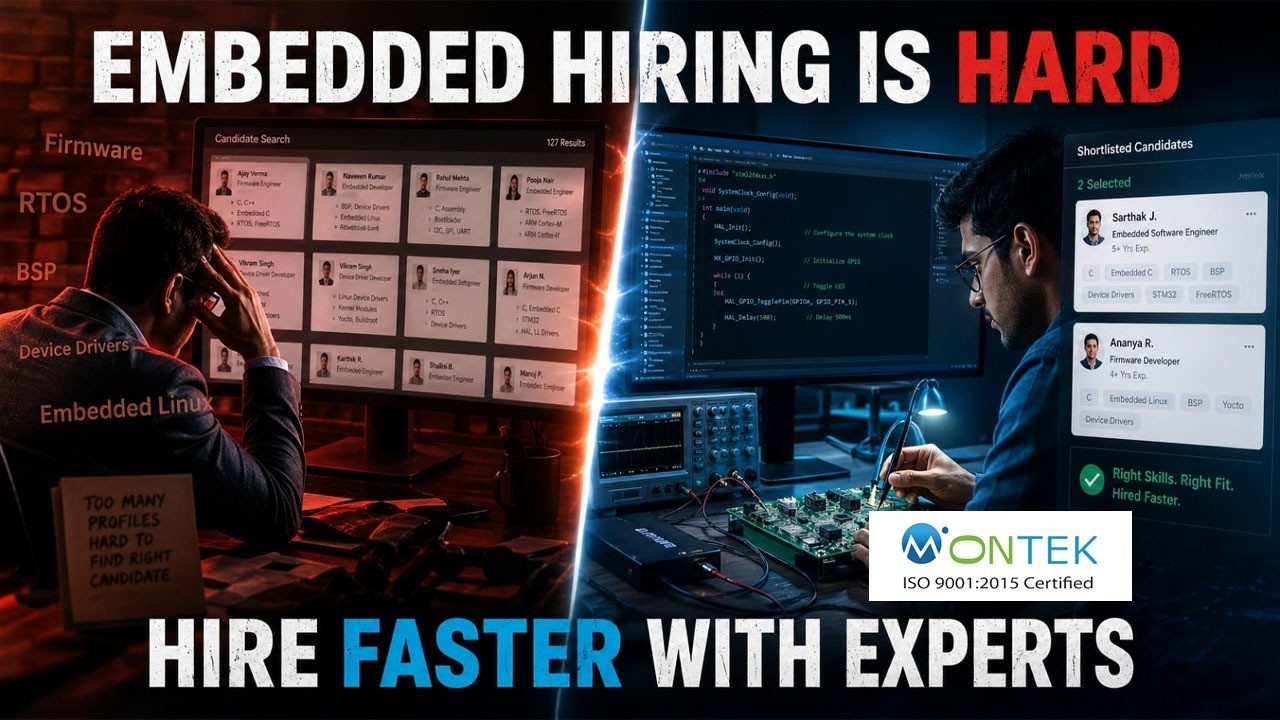
Hiring embedded engineers is rarely simple. The best candidates are often deeply specialized, selective about roles, and difficult to assess through generic hiring processes. For companies building connected products, automotive systems, industrial automation platforms, medical electronics, or smart devices, the cost of a slow or wrong hire can be high.
That is why embedded hiring in India now requires a sharper strategy. It is no longer enough to post a job description and wait for applications. Hiring teams need a focused approach to identify, evaluate, and close engineers with proven experience in firmware, board bring-up, RTOS, Linux kernel, BSP, and device driver development.
If your company is struggling to hire embedded talent fast, this guide will help you understand where the hiring bottlenecks are and how to solve them.
Why Embedded Hiring Is So Challenging
Narrow skill bands make screening harder
A strong embedded candidate may need experience in:
- C and Embedded C
- Microcontrollers and SoCs
- RTOS
- BSP
- Device Drivers
- SPI, I2C, and UART
- Debugging tools
Great embedded talent is often not actively applying
Many skilled embedded engineers are already engaged in product companies, semiconductor firms, automotive projects, or R&D teams. That means the best talent is often passive and must be reached through targeted hiring networks.
Interview rounds often fail to match the role
A common reason embedded hiring fails is poor interview design. A firmware engineer should not be assessed the same way as a Linux BSP engineer. When interviews do not reflect actual project requirements, companies lose qualified candidates.
The Most In-Demand Embedded Roles
Firmware Engineers
Firmware engineers work close to the hardware layer and build reliable low-level code for controllers, peripherals, and product logic. They are commonly hired for consumer electronics, industrial products, and IoT.
BSP Engineers
Board Support Package engineers are critical when companies are working on custom hardware or embedded Linux systems. These roles require strong knowledge of board bring-up and bootloaders.
RTOS Engineers
RTOS specialists are important for systems that demand deterministic performance. These engineers are valuable in automotive, robotics, and safety-critical applications.
Device Driver Engineers
Device driver engineers build the software interface between hardware and the OS. Practical experience in low-level hardware interaction is key here.
Embedded Linux Developers
Embedded Linux developers are highly sought after for networking devices and edge systems. They work across kernel, middleware, and application layers.
What Slows Down Embedded Hiring
- Vague job descriptions: Generic terms like “embedded engineer” make talent mapping difficult.
- Broad criteria: Listing every tool as mandatory discourages strong candidates.
- Delayed scheduling: Top talent is often off the market in days, not weeks.
- Weak pre-screening: Interviewing mismatched candidates wastes management time.
How to Hire Embedded Engineers Faster
Direct Answer:
To hire embedded engineers faster in India, companies must define the specific technical environment, vet candidates for project-specific experience, and work with specialist recruitment teams that maintain pre-mapped talent pools.
1. Define the exact embedded environment
Clarify whether the role is focused on bare-metal development, RTOS, embedded Linux, BSP, or kernel and driver work.
2. Screen for project relevance
Look for production-level experience, debugging depth, and the ability to resolve field issues in real deployments.
3. Build role-specific interview tracks
- Firmware: Memory, interrupts, and peripherals.
- BSP: Boot flow, board bring-up, and hardware initialization.
- RTOS: Scheduling, timing constraints, and task handling.
- Driver: Low-level hardware interaction and DMA concepts.
4. Use a specialist recruitment partner
A niche hiring partner can help you access pre-mapped embedded talent, reduce shortlist mismatch, and speed up the overall hiring cycle.
Why Specialist Recruitment Delivers Better Results
- Niche talent mapping
- Faster sourcing turnaround
- Passive candidate outreach
- Better technical alignment
- Interview coordination
- Offer conversion support
Who Should Read This Blog
- CTOs and engineering heads
- Talent acquisition teams
- Founders building embedded product teams
- Semiconductor and electronics companies
- Automotive and industrial technology employers
Why Montek Services Can Help With Embedded Hiring
If your business needs embedded hiring support, working with a recruiter that understands deep-tech roles can significantly improve hiring efficiency. Montek Services supports niche hiring needs across technical domains and can help companies identify the right embedded engineering talent faster.
Scale Your Embedded Team Today
Join leading semiconductor and automotive firms using Montek's niche technical vetting to close roles faster.
Get Specialized Talent Support? 15+ Years Expertise | ? 500+ Engineers Placed | ? Niche Technical Vetting
Conclusion
Embedded hiring in India is competitive, technical, and highly role-specific. Companies that define roles clearly, assess candidates properly, and move quickly are far more likely to secure top firmware, BSP, RTOS, and device driver talent.
If you are planning to scale your embedded team, a focused recruitment strategy can help you reduce delays, improve shortlist quality, and convert the right candidates faster.
Contact Montek Services for niche embedded staffing support
Related Resources and Links
- HR and Recruitment Services – Explore comprehensive HR solutions.
- Embedded Staffing – Specialized talent for technical roles.
- Contact Us – Get in touch for custom hiring needs.
- VLSI Hiring Blog – Insights into RTL, verification, and physical design talent.
- Embedded and AI Hiring – The intersection of AI and hardware.
- IT Recruitment Agency – Dedicated staffing for technology sectors.
- Offshore Development Center – Scale your tech team with Montek's ODC in Pune.
- Software Development Services – Custom software solutions for global businesses.
- Semiconductor Hiring 2026 – Building scalable chip design and verification teams.
Frequently Asked Questions
What is embedded hiring?
Embedded hiring refers to recruiting engineers who work on low-level software and hardware-linked systems such as firmware, BSP, RTOS, device drivers, and embedded Linux applications.
Why is embedded hiring difficult?
It is difficult because the skill sets are niche, role requirements vary widely, and many experienced candidates are passive rather than actively job searching.
How can companies speed up embedded hiring?
Companies can define the exact role clearly, improve technical screening, reduce interview delays, and use a specialist recruitment partner.
Which industries need embedded engineers most?
Automotive, industrial automation, consumer electronics, IoT, telecom, robotics, healthcare devices, and semiconductor-linked product development all depend heavily on embedded talent.
What are the key differences between firmware and BSP roles?
Firmware engineers write bare-metal code that runs directly on microcontrollers, while BSP engineers focus on board bring-up, bootloaders, and integrating hardware with an embedded Linux kernel.
What interview topics should I evaluate for an RTOS engineer?
Assess knowledge of task scheduling, timing constraints, semaphores, mutexes, inter-process communication, and real-time performance tuning.
How important is passive candidate outreach in embedded hiring?
It is very important because many top embedded engineers are already employed and need targeted outreach through professional networks and specialist recruiters.
What common mistakes make job descriptions vague?
Using generic terms like “embedded developer” without specifying the stack, and listing overly broad mandatory tools or protocols, often makes descriptions unclear.
How does a specialist recruitment partner accelerate hiring?
They maintain niche talent maps, conduct pre-screening, manage passive outreach, align technical criteria, coordinate interviews, and support offer conversion.
What metrics should I track to improve embedded hiring speed?
Track time-to-fill, number of qualified candidates per role, interview cycle length, and offer acceptance rate.
Can hiring multiple embedded roles in parallel cause bottlenecks?
Yes. Without clear role definitions and dedicated interview tracks, interviewers may get overloaded, leading to delays and candidate drop-off.
Why choose Montek Services for embedded staffing?
Montek Services specializes in niche embedded recruitment, offering deep technical vetting, fast sourcing, and end-to-end hiring support in India.
How does AI and SEO influence embedded hiring trends?
AI tools can support smarter talent matching, while SEO-friendly content helps technical hiring pages and blogs reach the right audience online.
What is the impact of geographic location on embedded talent availability?
Tech hubs such as Pune and Bangalore have strong embedded talent pools, but remote hiring and regional talent mapping remain important for scaling specialized teams.
Author -
CEO