We partnered with Montek for the development of our eCommerce platform, HerCliq.com and the experience has been nothing short of outstanding. From the initial concept to the final launch, Montek's team demonstrated deep ...
MK

Connecting ideas and people – how talk can change our lives.
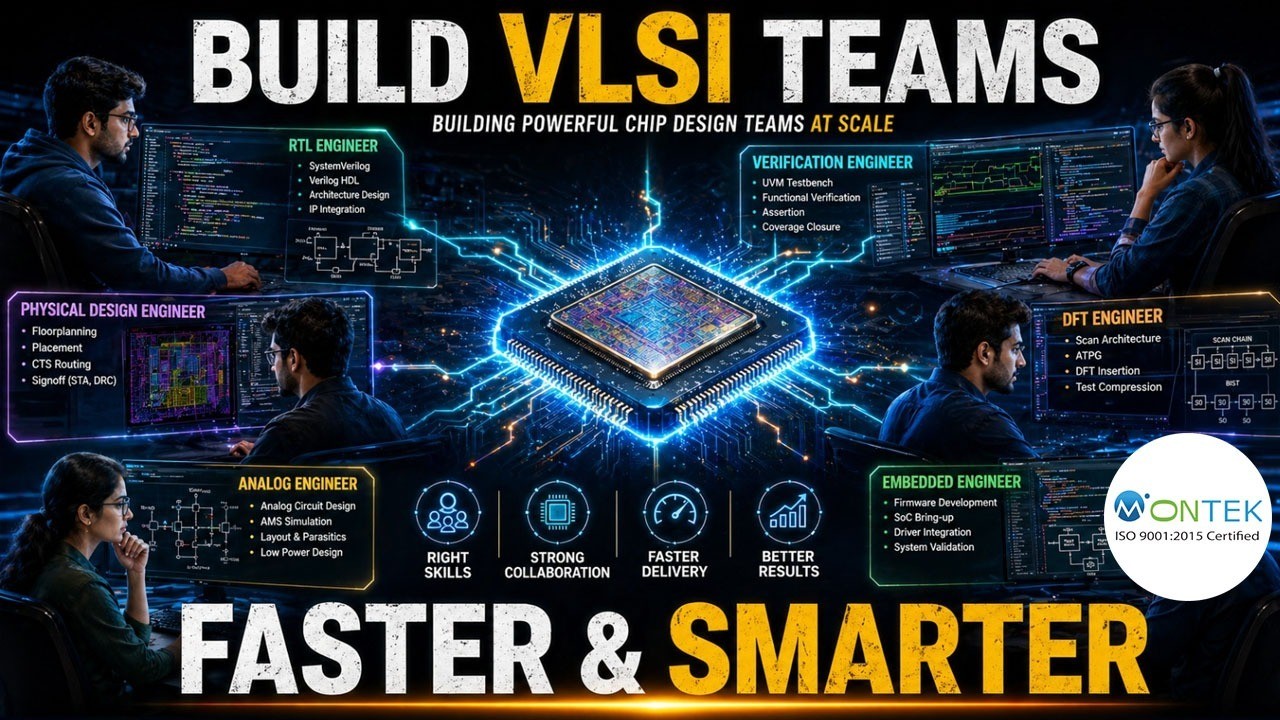
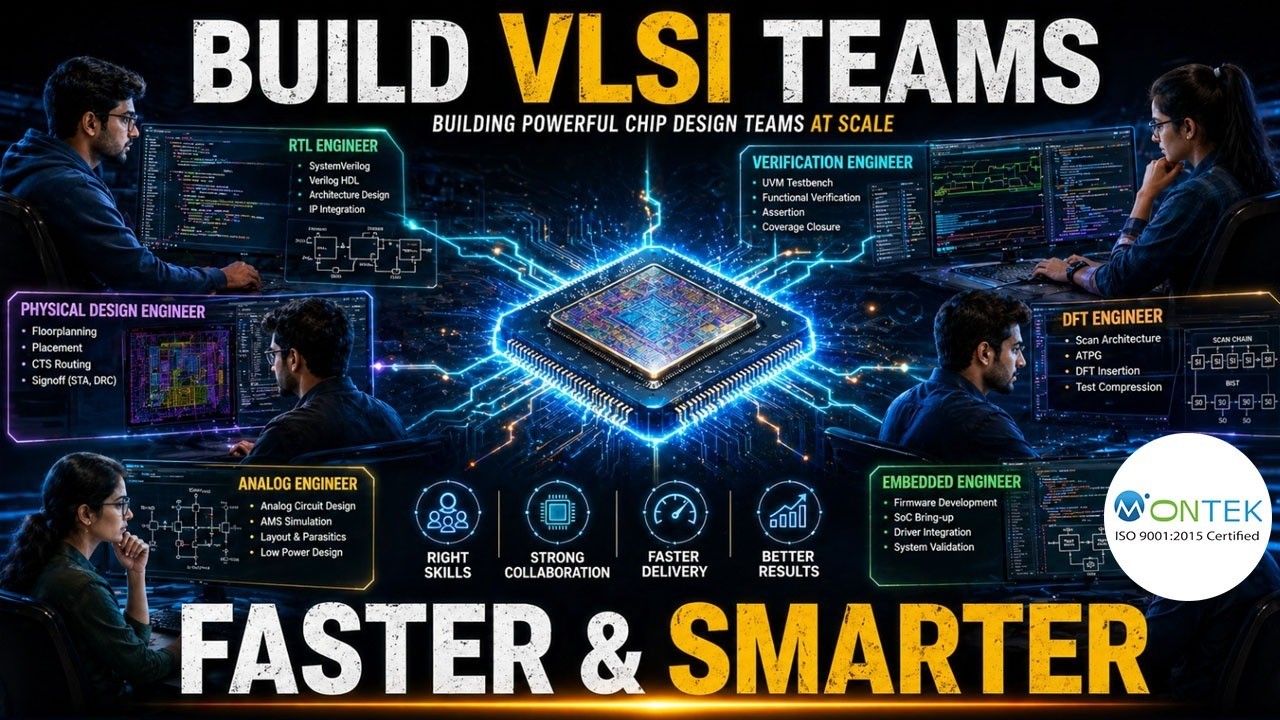
Semiconductor hiring in India has moved beyond isolated role-by-role recruitment. Today, many companies are not just hiring one or two engineers — they are building entire capability clusters across chip design, verification, physical design, DFT, embedded software, and platform engineering.
This shift creates a new challenge. Hiring success is no longer about filling one vacancy. It is about creating a scalable, reliable, and future-ready team. For businesses entering growth mode, semiconductor hiring requires a stronger strategy, better role planning, and a recruitment process that can keep pace with technical demand.
Semiconductor projects depend on interdependent roles. A company may hire RTL engineers, but without strong verification and implementation support, execution slows down. Similarly, platform-level product teams may require embedded software and system integration talent alongside core VLSI functions.
Semiconductor teams may need expertise in RTL Design, Verification, Physical Design, DFT/STA, Analog/Mixed-Signal, Embedded Software, BSP & System Integration, Application Engineering, and Validation & Testing.
When recruitment is reactive, delivery risk increases. A better approach is to map out critical roles, team dependencies, and planned hiring phases in advance.
Technical requirements are highly specific. Without detailed alignment, shortlists become weak and interviews waste time.
Top engineers usually have multiple options. Companies need faster coordination and stronger recruiter engagement.
Assessment standards vary between interviewers, leading to slow and unclear hiring decisions.
Senior semiconductor talent is difficult to replace quickly. Strategic workforce planning is essential.
Direct Answer: Building a scalable semiconductor team in India requires strategic workforce planning (defining senior-junior ratios), clustering roles by project dependencies (like pairing RTL with Verification), and establishing standardized interview benchmarks. With a projected talent gap of 200,000+ engineers by 2030, early team-building through specialized partners is critical to avoiding execution bottlenecks.
Define priority technical gaps, seniority mix, and backup hiring plans early.
Group hiring by tracks like front-end, implementation, or embedded software to improve sourcing efficiency.
Use predefined technical checkpoints for each track to assess profiles faster and more fairly.
Professionals evaluate roles based on technical challenge, growth potential, and process efficiency.
Many teams now need both silicon and software capability. Avoiding hiring silos creates stronger delivery alignment.
Generic hiring methods often struggle with niche semiconductor roles. Specialist recruitment support helps companies:
For companies building or expanding semiconductor functions in India, this can translate into faster team formation and lower hiring friction.
To hire better and faster, companies should focus on:
A disciplined process increases both quality and conversion.
Montek Services is positioned around specialized hiring and embedded staffing support, making the brand relevant for companies seeking recruitment help in niche engineering areas. For organizations scaling semiconductor teams, the right recruitment partner can help streamline sourcing, improve candidate alignment, and support sustained hiring activity across multiple technical roles.
Join the future of India's silicon landscape. Scale your design and validation clusters with Montek's niche engineering expertise. Start Scaling Your Team
Ecosystem Integration Partners | 2026 Readiness Focus | End-to-End Technical Vetting
Semiconductor hiring refers to recruiting talent for chip design, verification, implementation, testing, validation, embedded software, and related engineering functions.
It is difficult because roles are highly specialized, skilled talent is limited, and companies often need to hire across multiple interdependent functions at the same time.
They can scale efficiently by planning ahead, grouping roles into hiring tracks, standardizing interviews, and using specialist recruitment support.
Yes, many semiconductor programs also require embedded software, platform, BSP, driver, and validation talent depending on the product and project stage.
A capability cluster is a group of engineers with related skills hired together to build a specific competency within a design house.
It helps define senior-junior ratios and technical gaps early, preventing project delays caused by last-minute hiring pressure.
Standardized evaluation ensures that all candidates are assessed against the same technical benchmarks, leading to faster decisions.
By offering challenging technical ownership, clear growth paths, market-aligned compensation, and a professional recruitment process.
It is driving massive demand for indigenous design talent and shifting the focus from services to product-driven engineering.
Yes, aligning dependencies early ensures software teams are ready when hardware is taped out, reducing overall product time-to-market.
Key metrics include offer acceptance rate, time-to-fill for niche roles, and the technical retention rate of new hires.
We support phased hiring through niche talent mapping and technical pre-screening across VLSI and Embedded software domains.
Most teams prefer hybrid models due to the collaborative nature of hardware design and EDA tool security requirements.
We specialize in niche engineering recruitment, offering technical vetting and end-to-end support for scaling complex design teams.
Semiconductor hiring in India is no longer just about filling vacancies. It is about building connected teams that can support design execution, implementation, validation, and product success at scale. Companies that plan hiring early, define technical tracks clearly, and use specialist recruitment support are better prepared to build strong semiconductor teams without losing momentum.
Ready to build your scalable chip design team? Contact Montek Services to discuss your semiconductor team-building strategy.
We partnered with Montek for the development of our eCommerce platform, HerCliq.com and the experience has been nothing short of outstanding. From the initial concept to the final launch, Montek's team demonstrated deep ...
Montek Services is a highly skilled team with an eye for details. Our expectation meets 100%. The project management and communication works really well through the online project tools and the dedicated project manager ...
Montek's website design team far exceeded my expectations on every front, we have very high expectations. The end product is a beautiful website that define who we are as company. Every person I worked with at Montek was...