
29
AprVLSI Hiring in India A Complete Guide to Hiring RTL Verification Physical Design DFT and Analog Engineers
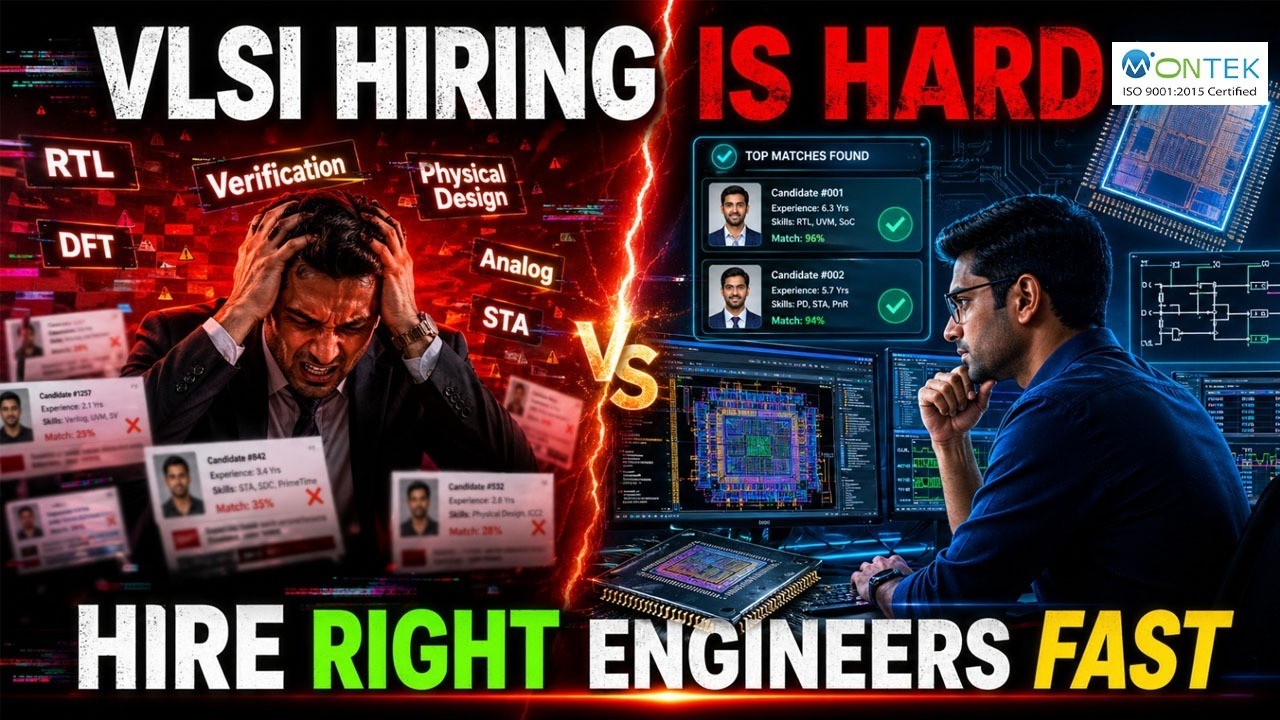
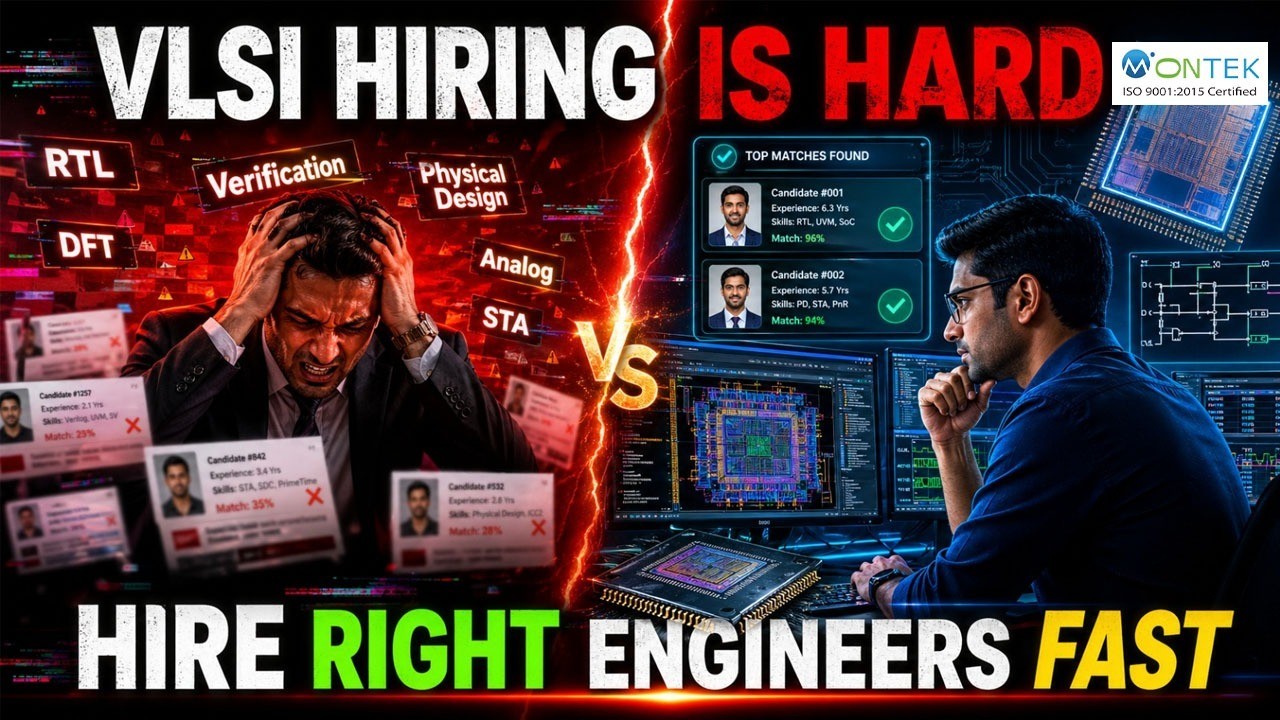
VLSI hiring in India has become one of the most critical priorities for companies building semiconductor design teams. As chip programs become more complex and tape-out schedules become tighter, the demand for experienced VLSI professionals continues to rise.
However, hiring in this space is not like standard engineering recruitment. Each function within VLSI demands highly specific expertise. A strong RTL design engineer is not interchangeable with a physical design specialist. A verification engineer may have excellent UVM experience but limited exposure to emulation or formal verification. An analog designer may be exceptional in circuit design but not suitable for mixed-signal integration.
To hire the right VLSI talent, companies need precision at every step.
Why VLSI Hiring Requires a Specialized Approach
VLSI recruitment is built around domain depth. Titles may look similar, but the underlying skills are often very different.
Every VLSI role has a distinct skill profile
A successful VLSI hiring strategy must separate roles such as:
Good candidates are usually already in demand
Experienced VLSI engineers often receive multiple opportunities at the same time. Companies that move slowly or fail to present a compelling opportunity may lose them quickly.
Technical screening must be role-specific
A verification engineer should be screened differently from an STA or physical design candidate. A one-size-fits-all interview process reduces both quality and speed.
The Core VLSI Roles Companies Need to Hire
RTL Design Engineers
Responsible for designing digital logic at the register-transfer level using HDLs. Requires strong architecture understanding and coding discipline.
Verification Engineers
Essential for design correctness. Evaluated on methodology strength (UVM), debugging capability, and structured flow experience.
Physical Design Engineers
Experts in implementation, floorplanning, placement, and timing closure. Critical for design optimization and tape-out success.
DFT Engineers
Focus on testability, scan insertion, and ATPG. Vital for large-scale chip development and manufacturability.
Analog & Mixed-Signal Engineers
Critical for high-performance and power-sensitive designs. Requires deep circuit fundamentals and experience-based intuition.
Common Mistakes That Slow Down VLSI Hiring
Generic job descriptions
Vague descriptions create confusion. Specify if it's front-end, PD, DFT, or Analog.
Combining requirements
Asking for RTL, DV, and STA all in one role makes sourcing nearly impossible.
Misaligned compensation
Specialized VLSI profiles compare multiple offers; alignment with market is crucial.
Delayed decision-making
Long feedback cycles cost companies top candidates in active markets.
How to Build a Faster VLSI Hiring Strategy
Direct Answer:
To speed up VLSI hiring in India, companies should shift from generic 'VLSI' requirements to domain-specific tracks (RTL, DV, PD, or DFT), automate technical screening for UVM/SystemVerilog proficiency, and target passive talent pools through specialized recruitment partners.
1. Define the role in technical terms
Specify function, years of experience, project stage, and EDA tools used.
2. Prioritize relevant project exposure
A candidate with tape-out experience at similar complexity is more valuable than a generalist.
3. Structure interviews around actual work
- RTL: Logic design, coding quality, architecture.
- Verification: Testbench strategy, debug methodology.
- Physical Design: Timing closure, congestion handling.
- DFT: Test logic, scan strategy, fault coverage.
Map candidates faster and improve shortlist quality through technical vetting.
What Hiring Managers Should Look For
- Deep function-specific expertise (UVM, STA, Synthesis)
- Clear understanding of the design flow
- Debugging and problem-solving ability
- Collaboration with adjacent teams (e.g., RTL with Verification)
- Ownership of deliverables and tape-out history
Accelerate Your VLSI Hiring Today
Join elite semiconductor design houses using Montek's niche technical vetting to close complex VLSI roles faster.
Get Specialized VLSI SupportConclusion
VLSI hiring in India is highly specialized and increasingly competitive. Companies that define roles clearly, use role-specific assessment methods, and move fast are better positioned to secure the right RTL, verification, physical design, DFT, and analog talent.
If your business is expanding semiconductor design capability, a sharper VLSI hiring process can reduce delays, improve candidate quality, and increase offer acceptance.
Related Resources & Links
Frequently Asked Questions
What is VLSI hiring?
VLSI hiring is the process of recruiting engineers for semiconductor design roles such as RTL design, verification, physical design, DFT, STA, analog, and mixed-signal engineering.
Why is VLSI hiring difficult?
It is difficult because each role demands niche expertise, the talent pool is specialized, and experienced engineers are often evaluating multiple offers.
How can companies improve VLSI hiring?
They can improve VLSI hiring by using clear role definitions, function-specific interviews, faster decision-making, and specialist recruitment support.
Which VLSI roles are most in demand?
Common high-demand areas include RTL design, verification, physical design, DFT, analog design, and mixed-signal engineering.
Why is verification so critical in VLSI?
Verification ensures design correctness and coverage before tape-out, preventing extremely costly hardware bugs and re-spins.
How does AI influence VLSI hiring in India?
AI is increasingly used in EDA tools, requiring engineers who understand AI-driven optimization and automated design flows.
Where are the VLSI hiring hubs in India?
Major hubs include Bangalore, Hyderabad, Pune, and Noida, where large semiconductor firms and design houses are concentrated.
Author -
CEO